
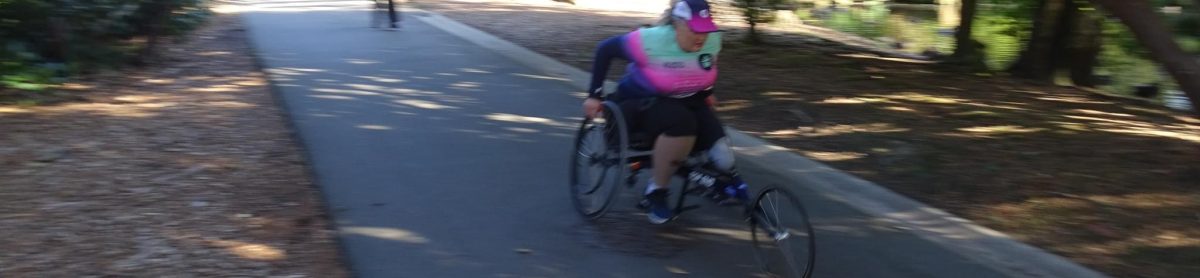

At the weekend, my husband and I walked or should I say st(rolled) parkrun at a leisurely pace for a change. This resulted in the opportunity to chat as we went, something we can’t usually do! An interesting topic came up, a comment on which has stuck in my mind ever since.
I was reflecting on the past 5 or so years of being an amputee and the years that have succeeded my last race as a triathlete.
I have, since I could no longer race triathlon, really struggled to find some focus, purpose and drive. So much so that for a long while I did not exercise at all. The way I rationalised it was if I cannot be the best then I do not want to be anything at all.
Then I got restless. Then I was despondent, and around the hamster wheel I went. In my first year as an amputee my OT struggled to get me to ‘relax’. The thing was, to ‘relax’, I trained. That has been the way for as long as I can remember way back into my thirties. So, when exercise is fraught with disability related problems, what does one do instead? It took me almost 5 years to figure this out.

So then, where does exercise fit into my life now? Good question.
Racing
Racing, by the nature of the word (and my ASD) has always meant going as fast as possible to try and beat as many people as you can and be as near to the top as you can.
This was the approach I always took when I was on the triathlon circuit and racing for team GB. This is not the approach everyone else takes though. Some people are there for the enjoyment of it all regardless of the result. I am sure you know that but this has always been an alien concept to me!
When I could no longer be the fastest and the best, I looked for different challenges by the way of longer, further or harder races. Long story short, I hated long. My muscles were not designed to go long. There is a reason I was a sprint triathlete, and it is not because it was the fastest way to get back to the hotel for breakfast! (although that is also true actually haha).
I was forced to stop and re-evaluate everything the day I failed to finish challenge Wanaka, the year my father was here to watch (making the whole thing ten times worse for me and my mind). This was my first ever DNF. I was devastated. I have not entered any races since.
Fitness
The journey that got me to the amputation table is actually very unorthodox and I often forget all of that too. For the 5 years prior to any left foot issues cropping up, I was battling a totally destroyed right knee, and waiting on a very long public wait list for a total knee replacement. That whole time I could not exercise, in fact I could barely even walk. Even swimming was causing me pain. I was only a few months post surgery when the left foot joined the party. my TKR rehab had barely even got started. This means that I had roughly 8-10 years of injury (of some sort or another) on the run up to the left leg being amputated below the knee.


When I look back at this data, I wonder what cloud I was on when I thought Challenge Wanaka was a feasible target just 12 months post amputation!
So eventually, I was forced to look at this from a completely different angle: fitness – for fitness’ sake. There’s another alien concept for me! Was I even able to get on board that train?
Enjoyment
I enjoyed racing. I enjoyed the hurt I forced myself through in racing. I enjoyed the pain of finding the last few ounces of energy you never thought you had when you needed it the most. I actually enjoyed that and that predominantly is why I loved triathlon. My best photographic example of that is this finish photo below and my race report from the European Champs in Israel in 2012.

When I cannot race, how and where do I find this now? Well it has taken me five years to get to the point where I can even start to relate some of the enjoyment and drive I got from triathlon to the training I am able to do at the moment.
I attribute this to the fact that I majorly underestimated how long rehab takes (physically and mentally) from the loss of a limb. I spent so long comparing myself to others I knew with other types of disability and health issues and felt like everyone else was springing back to normal easily and rapidly, and I wasn’t. I thought I was doing something wrong. Or worse still, perhaps I was failing.
What I know now
- You do not get back to fitness from ten years of accumulated injuries in a matter or mere months. It took me many years to get to the bottom, it is going to take many to get back out of this pit again.
- It is possible to enter a race and in fact enjoy it, without actually ‘racing’ it in the most literal sense of the word. Even though I have not personally done a race for this reason… yet. First though, I need to be absolutely sure in myself that I can actually complete the required distances. Added to all this, I am not getting any younger and I am constantly comparing myself to my fitter, 30+ year old self. That in itself is an unrealistic comparison.
- I can make gains, there is no time limit on when this can happen. An old coach I used to have told me once that I simply was not good enough to get any faster. I did not accept that at the time, and still don’t, even now. The only limits we have are set by our minds. So yep, that coach got flicked on and I found a new one. Nowadays, there just is no one who has more in depth knowledge of triathlons, training and racing with the complex set of disabilities that I have. I do not need a coach, like I always thought I had to have. I now need to apply the data and listen to my body. I have everything within me that will enable me to achieve anything I want to achieve. I just need to be realistic with the time frames.


Recent data proves:
- I have been able to get my cadence back up to 80-90 rpm.
- I have more than doubled my wattage compared to what I was capable of immediately post amputation.
- I am able to push myself to the max within the safe confines of Zwift and my indoor trainer. This gives me that self inflicted pain factor that I miss from not being able to race!
The ‘buts’
There will always, however, be a few factors that remain out of my control. These are things I need to remain mindful of, in light of the fact that I am in fact permanently disabled, despite the fact that I often don’t class myself as such!
My left leg some days plays ball, some days it does not. There seems to be no rhyme nor reason why and when this might be. I don’t always know till 5kmish down the road. This is why I prefer to train indoors. I have not actually gone anywhere, should I run into issues and have to stop.
Will this always be the case? Who the hell knows!
On the occasions when the left leg is in a funk, I rely on my right more for power. This is not necessarily a good thing either, it makes the TKR get grumbly and painful!
I am still wrapping my mind around all of this. Some days I can cope, some days I can’t. Some days I can push through using the other side, some days I can’t.
But, on the days when I can not only keep going but push myself to the point of almost collapse, the point where I feel slightly nauseous from the effort – well I consider that a good day in the grand scheme of things! hahaha
conclusion
For someone who is a seasoned age group racer, they will understand this completely! For someone who has not been that person who wants to race at that level or intensity, this will all seem alien! however, I hope that the seemingly lengthy explanation to the title topic actually gives you some insight into the mind of an amateur athlete and why we put ourselves through it!

When I used to do triathlons (like 20 years ago) I always seemed to have an some issue somewhere, and somedays I would pull some weird muscle that I never previously knew about.
I used to just get on with it and do the best I could.
It was only the last few races I ever did where everything went ‘perfect’.
I’m sure a lot of triathletes can relate! IM world champs in Kona is on this weekend. The women’s race just finished, both #1 and #2 in the pro’s had to pull out during the run, then a complete newbie from Norway came thru to win! You never know what’s going to happen on race day!
I completely understand… As an Ironman..who 2 years ago got a THR and now need both knees done (bone on bone, Osteoarthritis) I have spent the winter trying to exercise myself into shape to determine if I need both knees done. Looking for pain which endurance athletes use to help them make decisions I rollercoastered all winter yes/no as my options grew more limited. No running, walking hurt, more than biking or swimming.. Once I made the decision to get the TKR the pressure disappeared.
Exactly. As you will know, the bone on bone hurt is different entirely. Hope your rehab went well and you’re now up and moving again.